The hip fracture at 80 starts in your forties
In brief
- Bone loss is fastest in the few years around your last period, and it starts about a year before it.
- Most of that loss can't be rebuilt, so prevention is what counts.
- Heavy strength training, enough calcium and vitamin D, and knowing your risk factors all help. Hormone therapy prevents the loss while you take it.
- Your forties are the time to act.
Longevity doctors often quote one statistic, and it's grim. A study of Ontario health records followed more than 100,000 adults over 65 after a fragility fracture. In the year after a hip fracture, about 1 in 5 women (21.5 percent) died, compared with 1 in 20 (5.1 percent) women of the same age who hadn't broken a hip1.
Many who survive don't go home. A second Ontario study looked at women who were living independently when they broke a hip. Within a year, 24 percent of them were in long-term care2.
The average woman who breaks her hip is 823. So why should a woman in her forties care? Because the hip that breaks at 82 was weakened decades earlier. Much of that damage happens in a few fast years around menopause.
How estrogen protects your bones
Your skeleton isn't the fixed frame it looks like on an X-ray. It's more like a city under constant renovation. Demolition crews (cells called osteoclasts) are always tearing down small patches of old bone, and construction crews (osteoblasts) follow behind, rebuilding each patch with fresh bone. The turnover is so steady that most of your adult skeleton is replaced about every 10 years. The bones you have today are not the bones you had at 30.
What changes over a lifetime is the balance between the two crews. Until about 25, construction outpaces demolition, so bone density climbs. From about 25 to 50, they roughly match. Whatever you have at that plateau is your bone bank for the rest of your life.
Estrogen is one of the main things keeping the demolition crew in check. When it falls at menopause, demolition speeds up and construction can't keep pace. The bone's inner scaffolding thins, develops holes, and in places disappears entirely. The outer shell thins from the inside and turns porous.
The result: 40 to 50 percent of women will break a bone because of osteoporosis at some point after menopause.
Can the damage be reversed?
Mostly no, which is the whole reason timing matters. Once the inner scaffolding is torn down, the construction crew can thicken the beams that are left, but it can't rebuild the ones that are gone. The structural damage done during the fast-loss years is irreversible. Most osteoporosis drugs slow demolition and modestly raise density, but they don't repair the lost architecture. Even the newer drugs that boost construction improve it only partly3.
That's why the first five years of menopause are the most important time to prevent bone loss, before the scaffolding goes3. Preventing the loss is far easier than rebuilding after it.
The bone loss that starts before your last period
It's easy to picture bone loss as a slow, steady slide in old age. It isn't. The fastest loss of your life happens in a short window around menopause.
A major US study called SWAN followed women through menopause and tracked their bone density year by year. It found that fast bone loss begins about a year before the final period. During these years, women lose roughly 2 percent of their bone a year, for several years running. Across the transition, the average woman loses 10 to 12 percent of the bone in her spine and hip4.
After that, loss slows to about 0.5 percent a year. But the damage adds up. By 80, the average woman has lost about 30 percent of her peak bone, and her hip density sits right at the threshold for osteoporosis.
Put those rates together and the shape of a lifetime looks like this:
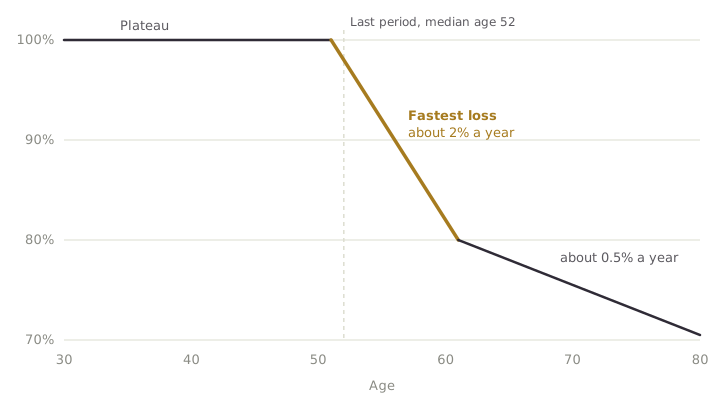
Bone density as a percent of peak. An illustrative curve built from the average rates in sources 3 and 4, not one woman's data. Individual women vary.
Speed matters too, not just where you start. In SWAN, women who lost spine bone faster in midlife had more fractures later, even when their starting density was the same. Each extra 1 percent of loss per year raised fracture risk by 56 percent5.
Now do the math. The median age of menopause in North America is 52, and the fast loss starts a year before that. So for the average woman, the steepest bone loss of her life begins at 51, with no symptom to announce it. There is no test she'll be offered, no pain, nothing to feel. By the time most women first think about their bones, the fast years are already behind them, and the bone that was lost isn't coming back.
That is why this article is aimed at women in their forties. It's the last decade in which the biggest loss is still ahead of you, and still preventable.
What to do, and when
Lift heavy things, starting now
Start with exercise. Canada's 2023 osteoporosis guideline recommends progressive strength training at least twice a week, including exercises for the back and abdominal muscles. It also strongly recommends balance training at least twice a week to prevent falls6.
"Progressive" is the key word. In an Australian trial called LIFTMOR, 101 women around age 65 who already had low bone density did heavy lifting and jumping exercises. They trained twice a week for 30 minutes, supervised, for 8 months. Their spine density rose 2.9 percent, while women doing gentle home exercise lost 1.2 percent. There were no fractures, and the only injury was one minor back spasm7.
LIFTMOR tested women in their sixties, not their forties. But if heavy training can build bone in women who already have thin bones, starting in your forties means entering the fast-loss years stronger. If you're new to it, or already know your bone density is low, start with a qualified trainer.
Calcium and vitamin D: enough, not more
This is where the popular story is most off. The North American Menopause Society calls it an "incorrect perception" that osteoporosis comes from a lifelong lack of calcium or vitamin D. Women with and without osteoporosis get similar amounts. Both work like thresholds: getting enough matters, but more than enough doesn't add benefit. Too much calcium, over 2,000 mg a day in total, is linked to kidney stones3.
Canada's guideline says women over 50 who get about 1,200 mg of calcium a day from food don't need a supplement6. So what does 1,200 mg look like on a plate? Dairy is the easy route: a cup of milk has about 280 mg, a cup of plain yogurt about 400 mg, and a matchbox-sized piece of cheese about 330 mg. Three or four dairy servings a day gets you there. Without dairy, the strong sources are canned sardines or salmon eaten with the bones (180 to 325 mg per 85 g serving), calcium-set tofu (about 250 mg per half cup), and fortified soy or almond milk (about 300 mg per cup)8.
Leafy greens are where the popular story goes wrong. Spinach is famous for calcium, but most of it is locked up by a compound called oxalate. Only about 5 percent is absorbed, compared with roughly 30 percent from milk. You would need about 16 servings of spinach to absorb what's in one glass of milk. Kale, broccoli and bok choy are the opposite: they hold less calcium per cup, but you absorb half or more of it. So a big salad helps, if it's the right greens, but it isn't a full day's calcium on its own.
One more absorption fact. The body takes in a smaller share from large doses, so if you do use a supplement, 500 mg or less at a time is absorbed better than one big pill.
Vitamin D is a different problem, because food barely has any. An 85 g serving of salmon has about 570 IU, but a cup of fortified milk has about 120 and an egg about 409. Sun works in summer: a fair-skinned person with arms and legs bare can make a day's worth in 14 to 30 minutes of midday sun, though people with darker skin need far longer. But from October to March, sunlight across Canada is too weak to make vitamin D at all. That's why Health Canada tells everyone over 50 to take a 400 IU supplement year-round. It's the one supplement here with an official recommendation behind it.
Know your risk before the scan is "due"
Canada's guideline recommends a bone density scan for everyone at 70. It recommends one earlier if you have risk factors: from 65 with one risk factor, and from 50 if you've had a fracture or have two or more risk factors6.
Some menopause specialists think that's too late. Dr. Mary Claire Haver, a board-certified gynecologist and certified menopause practitioner whose 2024 book The New Menopause was a New York Times bestseller, puts it bluntly: "Most guidelines say women should start bone density screening at 65. I believe this is too late for many women." She tells women to ask for a scan in perimenopause, or as soon as they have a risk factor, rather than waiting10. Her argument is the same one this article makes: a baseline scan before the fast years lets you act while prevention still works.
In BC, that scan may not be free. The provincial requisition form lists "screening around menopause" and routine screening under 65 as services MSP does not cover. It covers the scan when you have a moderate or higher fracture risk, which in practice means one major risk factor or two minor ones11. If you don't qualify, private imaging clinics in Vancouver charge roughly $150 to $300 for a bone density scan. Ask your doctor whether you meet the criteria before you pay.
The guideline's risk factors include a broken bone after age 40, a parent who broke a hip, smoking, three or more drinks a day, low body weight, two or more falls in the past year, and long-term steroid use. Rheumatoid arthritis and menopause before 45 also raise risk. If any of these apply to you, raise it with your doctor in your forties rather than waiting.
Hormone therapy: timing is everything
Estrogen, the hormone whose loss drives the fast years, also prevents that loss when it's replaced. The clearest test was a US trial called PEPI, which enrolled 875 women averaging 56 years old, all within ten years of menopause, and gave them hormones or a placebo for three years. The women on estrogen didn't just hold their bone. They gained 3.5 to 5 percent in spine density and 1.7 percent at the hip, at an age when untreated women are losing about 2 percent a year12.
Three catches matter:
- Timing. Starting estrogen more than 10 years after menopause isn't recommended because of heart concerns3. That puts the usual window for starting hormone therapy right on top of the fast-loss years.
- Whether to take it for bone alone is still being argued. Bone loss has no symptoms, and the experts don't agree on whether preventing it is reason enough to start hormone therapy. Canada's osteoporosis guideline, written by bone specialists, says yes only if you also want relief from other menopause symptoms such as hot flashes or poor sleep6. The Menopause Society goes further: for women under 60 or within 10 years of menopause, hormone therapy "is an appropriate therapy to protect against bone loss," though it still says the decision should rest mainly on symptoms and risks13. Dr. Haver goes further still, calling estrogen "a first-line strategy for bone protection in the menopausal transition"10. The view has been moving in one direction, and it's moving now.
- The protection lasts as long as you take it. Stop, and bone loss picks up again: in one trial, women who came off hormone therapy lost about 3 percent of their spine density in the first year14. Within a few years of stopping, fracture risk is back to about where it would have been without hormones, though not worse15.
This is a conversation to have with your doctor, ideally in perimenopause, when the decision has the most to offer.
After the window: don't fall
Most fractures happen after a fall from standing height or lower. That's why the guideline puts balance training alongside strength training, and why exercise has the most consistent evidence for preventing falls3. And unlike hormone therapy, there's no window: strong legs and good balance cut your chance of falling at 45 or at 85, for as long as you keep training.
The takeaway
A hip fracture at 80 isn't decided at 80. It's shaped by the bone you built, how fast you lost it in the years around your last period, and whether you stay on your feet.
The fast-loss years usually start around 50. Your forties are the runway: build strength, get enough (not extra) calcium and vitamin D, know your risk factors, and have an informed conversation about hormone therapy before the window opens, not after it closes.
Sources
- Brown JP, Adachi JD, Schemitsch E, et al. Mortality in older adults following a fragility fracture: real-world retrospective matched-cohort study in Ontario. BMC Musculoskeletal Disorders 22: 105, 2021.
- Nikitovic M, Wodchis WP, Krahn MD, Cadarette SM. Direct health-care costs attributed to hip fractures among seniors: a matched cohort study. Osteoporosis International 24(2): 659–669, 2013.
- North American Menopause Society. Menopause Practice: A Clinician's Guide, 6th edition (2019). Chapter 7, "Osteoporosis," pp. 159–172.
- Greendale GA, Sowers M, Han W, et al. Bone mineral density loss in relation to the final menstrual period in a multiethnic cohort: results from the Study of Women's Health Across the Nation (SWAN). Journal of Bone and Mineral Research 27(1): 111–118, 2012. See also the SWAN bone health fact sheet.
- Shieh A, Karlamangla AS, Karvonen-Gutierrez CA, Greendale GA. Faster lumbar spine bone loss in midlife predicts subsequent fracture independent of starting bone mineral density. Journal of Clinical Endocrinology & Metabolism 106(7): e2491–e2501, 2021.
- Morin SN, Feldman S, Funnell L, et al. Clinical practice guideline for management of osteoporosis and fracture prevention in Canada: 2023 update. CMAJ 195(39): E1333–E1348, 2023.
- Watson SL, Weeks BK, Weis LJ, et al. High-intensity resistance and impact training improves bone mineral density and physical function in postmenopausal women with osteopenia and osteoporosis: the LIFTMOR randomized controlled trial. Journal of Bone and Mineral Research 33(2): 211–220, 2018.
- National Institutes of Health, Office of Dietary Supplements. Calcium: Fact Sheet for Health Professionals.
- National Institutes of Health, Office of Dietary Supplements. Vitamin D: Fact Sheet for Health Professionals.
- Haver MC. Osteoporosis and Menopause: The Silent Fracture Most Women Miss Until It's Too Late. Substack, March 11, 2026.
- Government of British Columbia. Standard Out-Patient Bone Densitometry Requisition (form HLTH 1905).
- Writing Group for the PEPI Trial. Effects of hormone therapy on bone mineral density: results from the Postmenopausal Estrogen/Progestin Interventions (PEPI) trial. JAMA 276(17): 1389–1396, 1996.
- The North American Menopause Society. The 2022 hormone therapy position statement of The North American Menopause Society. Menopause 29(7): 767–794, 2022.
- Ascott-Evans BH, Guanabens N, Kivinen S, et al. Alendronate prevents loss of bone density associated with discontinuation of hormone replacement therapy: a randomized controlled trial. Archives of Internal Medicine 163(7): 789–794, 2003.
- Watts NB, Cauley JA, Jackson RD, et al. No increase in fractures after stopping hormone therapy: results from the Women's Health Initiative. Journal of Clinical Endocrinology & Metabolism 102(1): 302–308, 2017.
This article is general information, not medical advice. The medical professional who sees you in person may reach a different assessment, and their judgement takes precedence.